Showing posts with label breaking news. Show all posts
Brazil’s Petrobras Registers R$3.76 Billion Loss in Q3

Brazil’s Petrobras Registers R$3.76 Billion Loss in Q3

Despite recent company troubles, foreign investors continue to show interest in Brazil's oil giant.

By Lise Alves, Senior Contributing Reporter
SÃO PAULO, BRAZIL – Brazil’s oil giant, Petrobras, registered a loss of R$3.759 billion during the third quarter of 2015. According to company officials the losses stem from the effects of the significant depreciation of the Brazilian real during the period and the reduction of oil exports.
Petrobras' financial director, Ivan Monteiro, during Thursday's press conference, Rio de Janeiro, Brazil.
Petrobras’ financial director, Ivan Monteiro, during Thursday’s press conference, photo courtesy of Agencia Petrobras.
“The results reflect an increase in net financial expenditures due to the devaluation of the Brazilian real and the increase of expenditures with interest rates,” said Petrobras officials on Thursday during a press conference to announce the results.
According to company officials, during the quarter there was an R$5.396 million increase in net finance expense in relation to the same period last year as a result of foreign exchange losses despite the one percent increase in crude oil an natural gas production and increased domestic demand.
Despite the loss, the company’s balance for the period between January and September is still positive, registering profits of R$2.102 billion. Company records also show that the loss is 29.6 percent lower than that registered during the same period in 2014, of R$5.339 billion.
The accumulated net income for the first nine months of the year was 58 percent lower when compared to the same period in 2014.
The company’s net debt was R$402.3 million as of September 30, 2015, a 43 percent decrease when compared to December 31, 2014, when the company registered a debt of R$282 billion.
In early October Petrobras announced a plan which would reduce investments made by the company by US$15.3 billion during the next two years. According to Ivan de Souza Monteiro, the company’s financial director, however, this has not discouraged foreign investors.
“We will be abroad next week and have a full agenda of those, company and investors, interested in having Petrobras as partners,” said Monteiro during the press conference. Company executives are expected to visit several countries among them Mexico, the United States, China, Canada and the UK.
-Source
Appeal Court Judgment: I will win 100 times anytime, says Mark

Appeal Court Judgment: I will win 100 times anytime, says Mark

Appeal Court Judgment: I will win 100 times anytime, says Mark


By Henry Umoru
ABUJA- FOLLOWING the nullification of his election by the Makurdi division of the Court of Appeal and call for a re- run of the poll within 90 days, former Senate President David Mark said yesterday that he will win 100 times if conducted that period of time.
It would be recalled that the All Progressives Congress, APC Senatorial candidate for Benue South, Daniel Onjeh had challenged the decision of the National and State Assembly Petition Tribunal to uphold the election of Senator David Mark of the Peoples Democratic Party, PDP.
In a statement yesterday, Senator Mark urged his constituents to remain calm and be law abiding over the judgment, just as he asked his people not to be deterred by the verdict, but be strengthened ahead of the re-run.
In a statement by his Media Assistant, Paul Mumeh, former Senate President Mark said believed that he won the election convincingly, adding that he has no doubt that his constituents would turn out en masses to vote for him again.
He said, ” What ever the situation may be, one thing I know is that my people are solidly behind me . They also appreciate the fact that I have done more than enough to lift up Idoma nation to a position of eminence in the contemporary political history of Nigeria.
” I won the election clean and clear. If we go back to the polls 100 times , I will still win convincingly”,
Earlier yesterday, the Appeal Court had ordered a fresh election to Benue south Senatorial district.

Malema anti-Mandela comments those of an immature dope: Cope

Malema anti-Mandela comments those of an immature dope: Cope

Malema anti-Mandela comments those of an immature dope: Cope


Economic Freedom Fighter (EFF) leader Julius Malema.
Image by: Bafana Mahlangu

Congress of the People’s leader Mosiuoa Lekota said Julius Malema’s attacks on former president Nelson Mandela's legacy were immature and uninformed.

“The Congress of the People (Cope) rejects Julius Malema's immature and uninformed claim that our late President Nelson Mandela sold out the struggle of the people and of South Africa; and that he deviated from the Freedom Charter,” Lekota said in a statement.
“Mandela reconciled black and white in our country and guided us away from what could so easily have turned into a massive bloodbath in our country. Mandela ensured that infrastructure, so essential to our economy, remained intact and undestroyed so that the platform existed for the economy to expand to accommodate the nation at large. That the present Government is failing dismally to take the country into the future is not Nelson Mandela’s fault by any stretch of the imagination.”
The Economic Freedom Fighters leader criticised the late former president, saying that he had turned his back on parts of the revolution after being released from prison.
Malema was addressing the Oxford Union in the United Kingdom on Wednesday and was responding to a question on whether Mandela betrayed the people of South Africa in exchange for political power.
"The deviation from the Freedom Charter was the beginning of the selling out of the revolution. But why did Nelson Mandela sell out the Freedom Charter? When Mandela returned from prison he got separated with Winnie Mandela and went to stay in a house of the rich white men... he was looked after by the Oppenheimers," Malema was quoted as saying. 
Lekota added that the nationalisation that Malema has been talking about was tried by socialist countries as well as many African countries with all of the failing.
“Mandela led democratically and the decisions that were taken in 1994 and subsequently came from a collective where debate flourished. Cope therefore roundly rejects Malema’s attack on Nelson Mandela.  It is immature as well as uninformed,” he said.

Putin approves economic sanctions against Turkey after downing of fighter jet

Putin approves economic sanctions against Turkey after downing of fighter jet

Putin approves economic sanctions against Turkey after 

downing of fighter jet

Putin approves economic sanctions against Turkey after downing of fighter jet
File photo of Russian President Vladimir Putin
MOSCOWNov. 28 -- Russian President Vladimir Putin on Saturday signed a decreeimposing economic sanctions against Turkey after Turkey shot down a Russian warplanenear the Syrian-Turkish border Tuesday.
The presidential decreewhich was posted at the website of the Kremlinsaid a ban ofcharter flights from Russia to Turkey will be introducedand Russian tourism operatorsshould stop selling tour packages to Turkey.
The decreewhich became effective immediately on the date of publicationwas entitled"On measures to ensure Russia's national security and protect Russian citizens fromcriminal and other illegal activities and the application of special economic measuresagainst Turkey."
In accordance with the decreeTurkish companies of transportation shall be restricted intheir operations in Russian territorieswith Turkish ships and boats being banned fromstaying at or navigating across Russian portswhile import of certain goods from Turkeywill be halted.
The visa-free travel regime between Russia and Turkey is also formally suspended andTurkish citizensexcept Turkish diplomats and their dependents and those with temporarypermits of residenceare not allowed to enter Russia starting Jan. 1, 2016, according to thedecree.
Russian employers are ordered not to extend contracts with Turkish nationals and willface restrictions in this regard.
Putin instructed Russian Foreign Ministry to inform the Turkish side of the contents of thedecree and ordered the government to prepared a detailed list of goodsfirms and jobsthat would be impacted.
Russia's move came after Turkey shot down Russia's fighter jet Tuesdaywith the latterclaiming that the Russian warplane violated Turkish airspacewhich Moscow vehementlydenied and insisted the Su-24 fighter jet stayed over Syria during its flight.
Putin had warned that Turkey's downing of the Russian fighter jet would have seriousconsequences for bilateral tiesMoscow had vowed to take measures in response toTurkey's downing of the Russian warplane.
Putin on Thursday demanded an apology from the Turkish leadership and a compensationfor the damagewhile Russian Prime Minister Dmitry Medvedev ordered the relevantgovernment departments to prepare the draft of possible economic sanctions againstTurkey.
Earlier on SaturdayTurkish Foreign Ministry issued a travel warningurging Turkishnationals to postpone their visits to Russia unless absolutely necessarywhile TurkishPresident Recep Tayyip Erdogan voiced regret over the incidentsaying his country was"truly saddenedby the incident and wished it hadn't occurred.

Massive Gold Deposit found 2000 meters Undersea in Shandong

Massive Gold Deposit found 2000 meters Undersea in Shandong

Massive Gold Deposit found 2000 meters Undersea in Shandong


Massive Gold Deposit found 2000 meters Undersea in Shandong
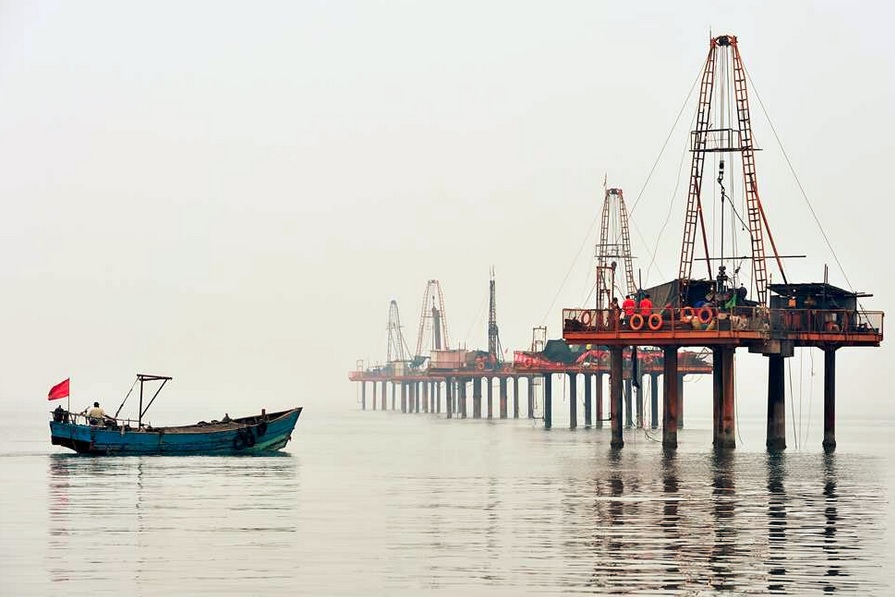
A mega-sized gold deposit with 470.47 tons of reserves was found in Laizhou, east ‪China‬’s Shandong province, announced the Shandong Provincial No. 3 Institute of Geological and Mineral Survey on Monday. The gold deposit was 2000 meters under the north coastal water near Sanshan Island. It is the largest and ever first undersea gold mine found in China.
According to Ding Zhengjiang, the vice director of the said institute, the gold deposit is part of a crablike ore belt that lies deep at the sea bottom. Invested by Laizhou Ruihai Mining Ltd, the marine ground investigation took three years and involved over 120 kilometers of drilling, with 67 sea drilling platforms and nearly 1,000 geological workers at most.
“It’s very difficult to locate and set up the drilling platforms at sea,” Ding said. In 2012, the first platform took 24 hours to be constructed, and now it took only 8 hours with more advanced offshore construction technology. “Besides, drilling holes into underground rocks that are more than 1000 meters deep is a big challenge,” said the project manager Zhang Junjin. “Normally in China, gold mine prospection is conducted within 800 meters underground. The discovery of a gold deposit lying 2000 meters undersea provides new drilling technology for future gold mining,” Zhang added.

Climate change protests across Australia – tens of thousands march

Climate change protests across Australia – tens of thousands march

Climate change protests across Australia – tens of thousands march

Tens of thousands of Sydney protesters call for a focus on the cost of climate change to Pacific Islands, while an unusually high turnout marches in Canberra
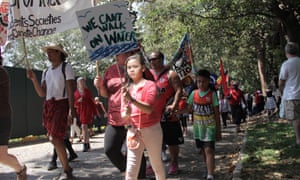
There was a strong Pacific Islander presence at the Sydney climate protest march on Saturday, raising awareness of the devastating impact rising sea levels on low-lying island nations.
 There was a strong Pacific Islander presence at the Sydney climate protest march on Saturday, raising awareness of the devastating impact rising sea levels on low-lying island nations. Photograph: Ben Doherty for the Guardian
Climate change rallies rolled on across Australia on Sunday, following well attended protests in Melbourne on Friday and Darwin and Brisbane on Saturday.
On Sunday, it was the turn of Sydney, Canberra, Adelaide, Hobart and Perth.
Australia’s climate-sensitive neighbours in the Pacific were a key focus for the climate change rally in Sydney, with representatives of communities from Pacific nations – including Tuvalu, Nauru, Kiribati and Tonga – prominent at the front of the march from the Domain to Circular Quay.
Dressed in red, they carried signs that read: “2C too late”, “We can’t walk on water”, and “Raise your voice, not sea levels”.
Previously, Pacific leaders such as Kiribati’s Anote Tong, and PNG’s Peter O’Neill have implored Australia to be the voice of the Pacific at climate change talks in Paris beginning Monday.
More than 40,000 people braved Sydney’s heat for the rally Sunday afternoon, calling on Australia to play a lead role in brokering binding emissions targets for the world to keep global temperature rise below 2C, and to commit to greater domestic emissions cuts than the 26% to 28% the government is currently proposing.
Despite the seriousness of the subject matter, the mood of the march was rumbustious, even festive. A salsa band played Arrow’s “Hot, Hot, Hot” all the way down Macquarie Street.
Sydney’s lord mayor, Clover Moore, told the march the COP21 meeting beginning in Paris on Monday would be “the most important meeting of our life time”.
“On it depends the future of our planet,” she said.
The prime minister, Malcolm Turnbull, announced Australia would contribute $1m towards the establishment of a Commonwealth climate finance access hub, to help small island states access funds for climate mitigation and adaptation.
“These countries have asked for assistance in accessing the climate finance they need to effectively deal with climate change,” he said in a statement.
The deputy opposition leader and shadow foreign affairs minister, Tanya Plibersek, spoke to reporters before the Sydney rally and said Australia’s contribution to the fund was “pathetically puny” and failed to comprehend the scale or imminence of the Pacific’s climate problem.
“Climate change is not a distant future threat for our Pacific neighbours, it is happening right now. You are seeing storm surges washing away coastlines, you are seeing saltwater creeping into fresh water sources, you are seeing drought preventing crops growing properly, making it harder for communities to feed themselves.”
Unlike Sydney’s spirited march, it was a very peaceful, family-oriented affair in Canberra, as people brought their children to march with them from Parliament House to the tent embassy, near Old Parliament House.
Police estimate about 3,000 people showed up, while protesters think the number was closer to 6,000. Canberrans are fairly cautious about protesting, as many are public servants and are often reluctant to make political statements.
One of the coordinators of the event, Emma Robinson from the Conservation Council, said she was not surprised that so many showed up in the capital.
“Climate change is and has always been everyone’s business,” she said.
The event was staffed by about 80 volunteers, most of whom were Canberra locals and part of the Conservation Council.
Former chief scientist of Australia, Penny Sackett, said that protests like Sunday’s made people feel as though they were taking action on climate change.
“People can become discouraged because it appears as though [political] change does not happen swiftly enough,” she told Guardian Australia.
She said the march was a message from voters to world leaders who are about to meet on climate change in Paris. “We’re watching.”
The Perth event started sombrely. At 3.25pm, at least 5,000 people sat in silence in Hay Street Mall to mark people who have lost their lives, homes and livelihoods to the effects of climate change. The group, in their colour blocks, had marched 2km from Wellington Square and stretched the whole 300-metre length, watched by bemused Christmas shoppers clutching plastic bags and taking photos of the crowd.
The march was led by a group from the Noongar Whadjuk nation and addressed by Christian, Islamic, Jewish, and Hindu faith leaders.
The aim, Perth assistant bishop Tom Wilmot said, was to show unity and tell political leaders that the will of the people was for change. “We can have prosperity without growth,” Wilmot said.
Kevin Jolley, president of the firefighters union of WA, who addressed the crowd in his heavy fire gear, said WA had already seen the devastating impact of climate change in its worsening bushfire seasons.
Six people died in bushfires in November, four in fires near Esperance, WA, and two in fires in South Australia.
It’s the deadliest Australian bushfire season since 2009, when 173 people died in the Black Saturday bushfires, and, Jolly said, it was only the start of the southern fire season.
“There are no [climate] sceptics at the end of a fire hose,” Jolly said.